

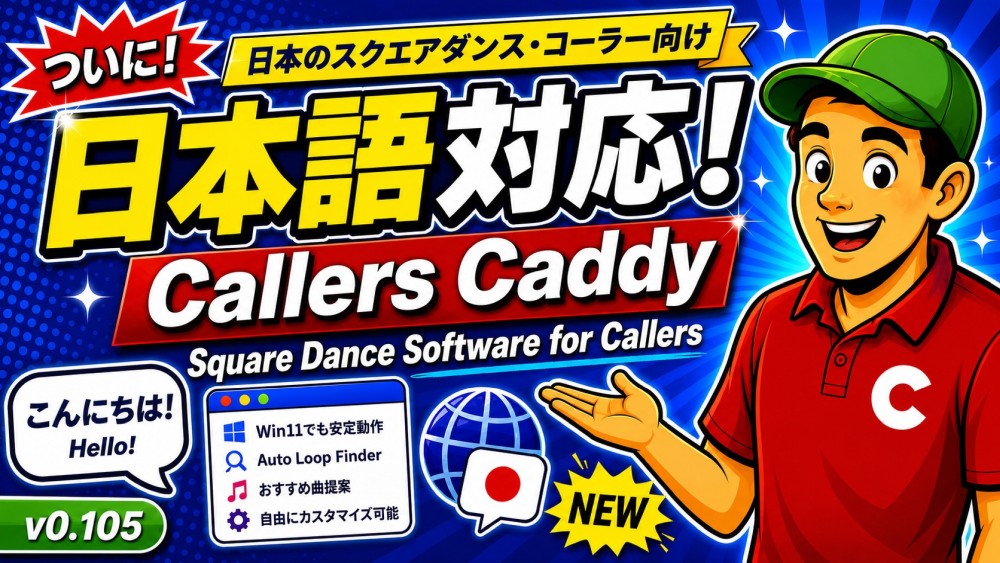
With version 0.105 Callers Caddy now has its first Japanese translation of the user interface.
This marks the next small but important step: The Callers Caddy is becoming more international.
The translation option was included from the very beginning.
The Callers Caddy was designed from the outset so that the interface could be translated.
The software launched with two languages:
German and English.
That was the obvious choice, since I myself come from Germany, but many square dance callers worldwide naturally use English. The technical foundation for additional languages was therefore already in place.
What was still missing was the specific occasion.
The trigger: Conversations with Osamu Otsuka from Japan
The inspiration for the Japanese surface design came from conversations on Facebook with Osamu Otsuka from Japan.
The discussion revealed that Japanese callers could also be interested in caller software. At the same time, language is of course an important factor.
So the simple question arose:
Why not simply test whether the interface of the caller Caddy can be translated into Japanese using AI?
30 minutes of AI translation for the entire interface
The real surprise was: The AI only needed approximately 30 minutes, to translate all user interface texts into Japanese.
That doesn't mean everything is automatically perfect.
But it means that a first working prototype was possible very quickly.
And that's exactly what this version is about.
From Callers Caddy 0.105 can the surface now also be used on Japanese can be used.
Square dance terms are intentionally kept in English.
One important decision was that the relevant terms from square dancing should not be artificially translated.
Many square dance calls, technical terms and typical expressions come from English and are also frequently used internationally in this form.
Therefore, these terms in Callers Caddy are deliberately kept in English.
The interface is designed to help Japanese callers find their way around more easily, without unnecessarily changing the familiar square dance language.
This is just the beginning.
I am fairly certain that the Japanese version still contains formulations that may be misleading, unusual, or simply wrong.
This is almost unavoidable with a first AI translation.
But that's exactly how development works:
A first version is being built.
They are made available to real users.
People listen to feedback.
And then it gets better step by step.
With every piece of feedback, the Japanese interface can become clearer, more natural, and more helpful.
Thanks to Osamu Otsuka
Special thanks go to Osamu Otsuka for the exchange so far.
Without these discussions, the idea probably wouldn't have come about so quickly.
I am very pleased to receive further feedback from Japan and am curious to see how this first translation performs in practice.
The caller's caddy keeps moving.
And from version 0.105 also in Japanese.