


Every caller has their own way of working.
One wants Adjust as little as possible. The software is intended to Think ahead and take work off your hands.
The other would prefer decide for yourself. He just wants to use what he has. deliberately tested has.
Both are perfectly fine.
This is exactly what you've been seeing in Callers Caddy for some time now.
There are different languages.
There are different layouts.
There are various themes.
With the new Rules Now, something important comes into play:
You can also customize the software's behavior to suit your style.
What are Rules?
Rules are rules based on a simple principle:
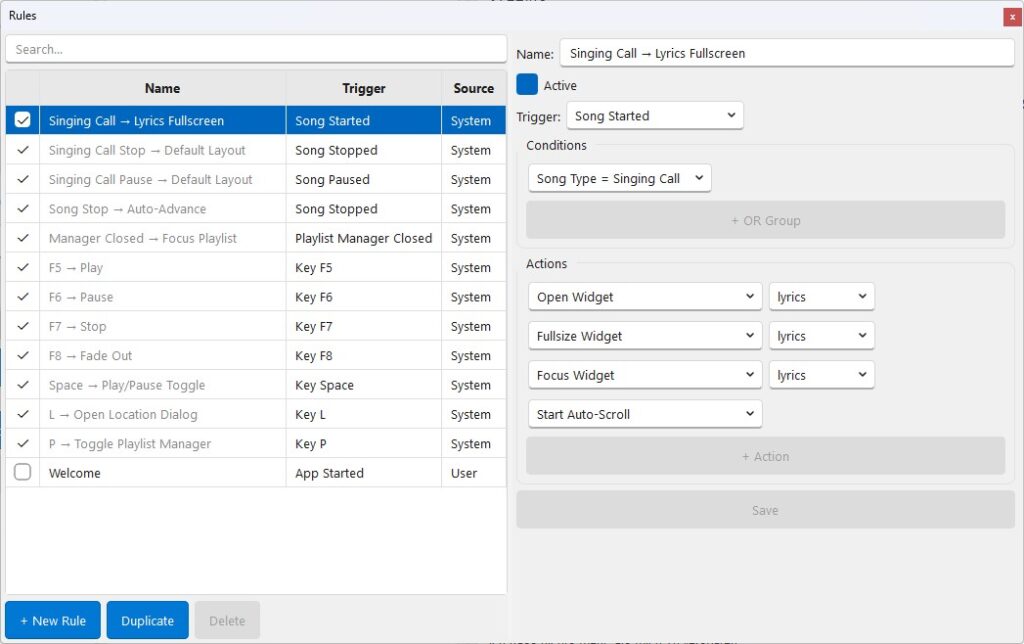
If something happens, Callers Caddy will automatically do what you have specified.
If requested, the Caddy will even check the conditions beforehand.
This is how an action happens not blind, but only then, if it really fits.
That sounds technical, but it's true in everyday life. very practical.
Why is this useful?
Calling involves many small processes that are constantly repeated.
A window is supposed to open.
Another one is supposed to disappear again.
The layout needs to change.
Lyrics should start.
A pattern still needs jump markers.
After a manager's departure, the focus should be back in the right place.
Until now, one had to do much of that do it yourself.
Now the caller's caddy can handle such procedures take care of you.
This saves clicks.
This saves attention.
And it helps you stay focused on your actual job: making calls.
The important point is: not everyone wants the same thing.
This is precisely where the great advantage of the Rules lies for me.
There is no single perfect behavior for all callers.
What is helpful to one person may bother another.
An example:
Some callers would like to As much automatic transmission as possible.
If a pattern is selected and no jump markers have been set yet, the caller's caddy may automatically find and enter the best loop.
Another caller wants exactly that.
He only wants to use loops that he I listened to it myself and consciously selected it. has.
That is also perfectly legitimate.
The Rules now allow both.
You use the automatic function there, where she helps you.
And you leave them out, where you prefer to decide for yourself.
The caller's caddy adapts better to you this way.
For me, this is the real core of this feature:
You don't have to adapt to the rigid specifications of the software.
The software can adapt more closely to your way of working.
That makes the caller's caddy flexible.
And it makes him personal.
There are already established rules.
You need to not starting from scratch.
There are already several in the Callers Caddy System rules built-in.
They cover typical procedures that many callers need.
For example:
- Singing Calls can automatically open the lyrics in full screen
- the Auto-Scroll can start appropriately
- After a stop or pause, the... normal layout appear
- important keys can fixed actions trigger
These rules are therefore a sensible starting point.
And you can create your own rules.
Additionally, there is User rules.
You can Create, modify, sort, and delete your own files.
This way you gradually build the exact process that suits you.
Perhaps you just want two or three small helpers activate.
Perhaps you would like to Automate many recurring tasks.
Both are possible.
Rules can be exported and imported.
That is especially practical.
You can use your user rules not only within your own system.
You can also export and later again import.
This has several advantages:
You can set your rules secure.
You can put them on a take over from another computer.
And you can use them with share with other callers.
Perhaps this might even lead to a small [business/project/etc.] later on. Rules Exchange.
So, a collection of useful rules that other callers can easily reload.
This is still just a preview.
But the The foundation for this is now in place..
My conclusion
The new rules don't just make the caller's caddy bigger.
He will primarily customizable.
You can Automating recurring processes.
You can Avoid unnecessary clicks.
And you can You decide for yourself how much automation you actually want..
That's exactly how it should be.
Because Not every caller works the same way..
So why should every software react the same way for everyone?
With the rules, the caller's caddy now has a behavior that better suits its user.